Plymouth GTX

Meet Chandler
Chandler has a bachelors and masters degree in history as well as a passion for classics and muscle cars. His education and historical knowledge makes him skilled at crafting highly detailed articles about America’s muscle cars and automotive history. His love of muscle cars is undeniable, with him seeking them out at every opportunity during his visits to auto shows and car meets. Chandler’s knowledge and enthusiasm towards automotive history make him a great asset to the Muscle Car Club community.
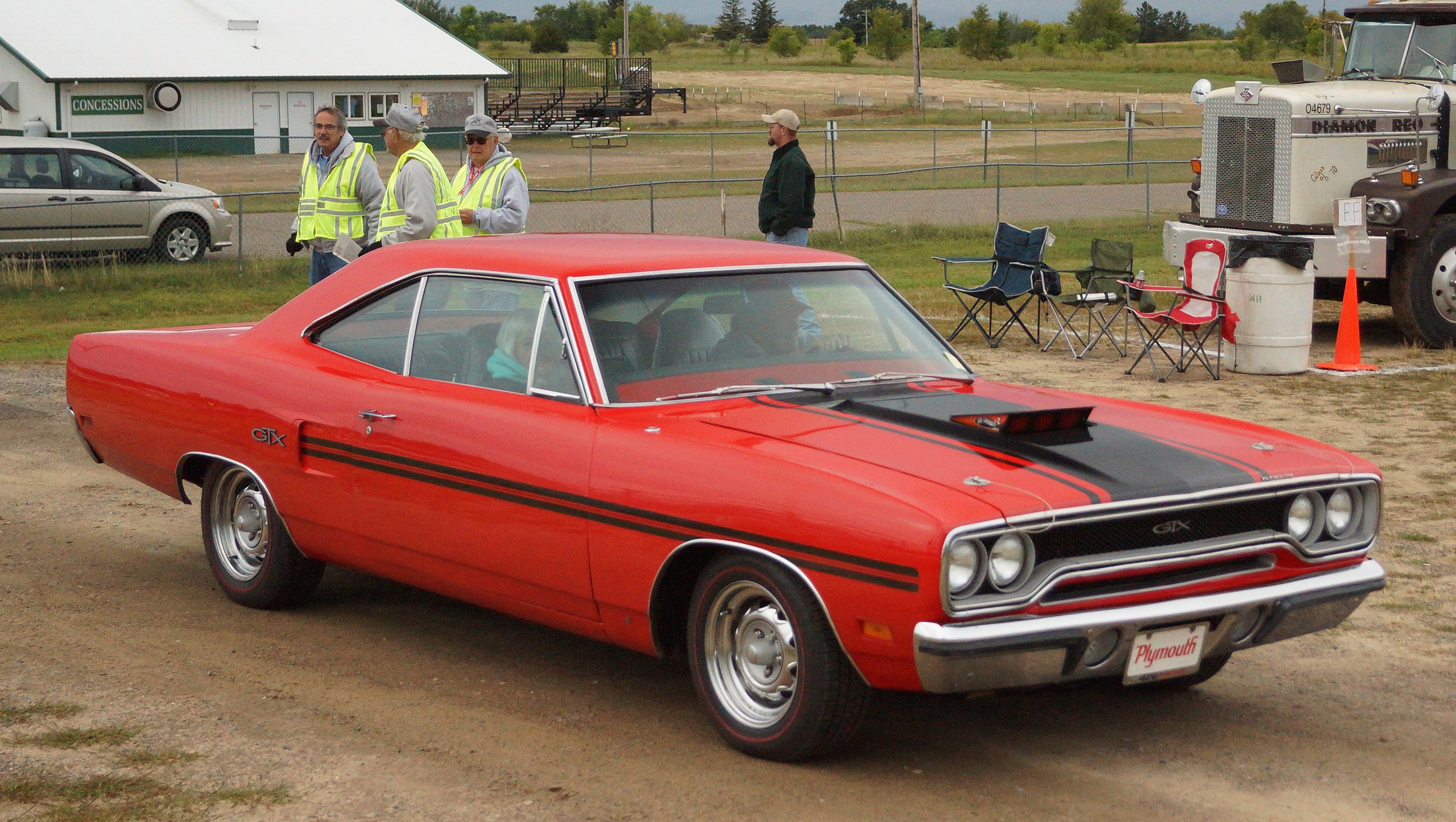
From 1967–1971, the Plymouth GTX was one of the top muscle cars available in all of America. Featuring only big-block V8 engines with sleek but subtle styling at an affordable price, the GTX stands out as a true icon of the muscle era. The GTX was the first performance vehicle that Plymouth offered, and they marketed it as the “Gentleman’s Hot Rod.” It was the ultimate combination of raw power and tasteful styling.
Today, the Plymouth GTX is one of the most sought out collectors vehicles from the muscle era. Especially valuable are models equipped with the awe inspiring 426 HEMI. Less than 1,000 buyers opted to get the HEMI-powered GTX annually, making them highly valuable. A direct competitor of the cheaper RoadRunner, the GTX was Plymouth’s muscle car king.
Plymouth GTX Overview
The Plymouth GTX spanned five model years from 1967–1971. Plymouth based the GTX on the already existing Belvedere, and the first model was officially the 1967 Plymouth Belvedere GTX. It resided on the Chrysler B-body platform, which also housed the Dodge Charger and Plymouth RoadRunner. Plymouth offered two engines with the GTX: Either a 440 cid Super Commando V8 or the iconic 426 HEMI V8. Instantly, the GTX was a success, and demand quickly grew.
Chrysler restyled the B-body line for 1968, which included a GTX makeover. It became sleeker and had more of an hourglass shape, though it was still based on the Belvedere. Essentially, the GTX was an upscale version of the Plymouth RoadRunner, which offered similar performance but with cheaper interiors and options. Plymouth offered the GTX as both a hardtop and convertible through 1969.
The Plymouth GTX underwent minor styling upgrades each year until 1971, but largely stayed the same. The most significant change for the GTX came in 1970, when Plymouth added the 440 Super Commando six-pack engine option. This was a 440 Super Commando, but the carburetor was three Holley double-barrels put together to make a massive six-barrel unit. It slotted just between the 426 HEMI and 440 four-barrel in terms of price and performance.
Following lackluster sales in 1970 and 1971, Plymouth discontinued the GTX. Coming emissions restrictions would have necessitated severely downtuning the power output on the big-block V8s anyways, defeating the point of a powerful muscle car. Today, there are still many Plymouth GTXs around on the streets, and they are one of the top collector muscle cars on the market.
1967 Plymouth GTX
Plymouth debuted the GTX for the 1967 model year. It was essentially a performance version of the Belvedere, rode on the same B-body, and was named the Belvedere GTX. These were the years when the muscle car era first started, inaugurated many would say by the 1964 Pontiac GTO. The 1967 GTX was Plymouth’s first foray into muscle cars, having previously entered the pony car game with the Plymouth Barracuda.
Compared with the standard Belvedere, the 1967 Plymouth GTX had a Pit Stop gas cap, red streak tires, DeLuxe wheel covers, dual fake hood scoops, and heavy-duty suspension, brakes, and battery. Price wise, the hardtop GTX cost $3,178, and the convertible added an additional $240 on top. This made them anywhere from a few hundred to over $1,000 more expensive than the standard Belvedere.
Of the two options – a 440 Super Commando V8 and 426 HEMI V8 – the Super Commando was cheaper and sold much better. Only 720 customers from 1967 are estimated to have opted for the HEMI package, with 408 getting the TorqueFlite automatic and 312 getting the four-speed floor-shifted manual.
The R023 GTX
Though little known, the Plymouth GTX could be offered with the R023 option-package, which many began to refer to as the SS or SuperStock package. The Plymouth GTX SS used the 426 HEMI and removed things like the heater unit, radio, hubcaps, insulation, and carpets, to shed weight. It also had a hood scoop that was actually functional unlike the fake GTX ones. It came with 4.88:1 gears – the highest ratios available – and a Dana 60 SuperGrip differential. Only 55 were ever built, making it extremely rare and valuable today.
Engine Technical Specifications
| Model Years | Engine | Horsepower | Torque |
| 1967 | 426 HEMI V8 (2x4bbl) | 425 horsepower | 490 lb-ft |
| 1967 | 440 cid V8 (4bbl) | 375 horsepower | 480 lb-ft |
Plymouth only had two engines available for the GTX: A 426 cid HEMI V8 and a 440 cid “wedge” Super Commando V8. Chrysler had introduced the 426 HEMI just the year prior, and in 1967 it made 425 horsepower and 490 lb-ft of torque. A $564 option, it was the largest and most powerful GT engine available at the time from Chrysler. The 426 HEMI had a 10.25:1 compression ratio, and for the carburetor used dual Carter AFB 3084-S four-barrels strapped together.
In comparison, the 440 Super Commando was 14 cid bigger but made only 375 horsepower and 480 lb-ft of torque. It had slightly lower compression at 10.10:1, and used a single Carter AFB 4326-S four-barrel carburetor. The Super Commando 440 was also from a different engine family, the Chrysler RB-series. Both engines also used iron blocks with five main bearings, and hydraulic valve lifters. The HEMI was engine code-L, while the Super Commando was code-J.
Plymouth offered two transmissions for the GTX: Either a three-speed TorqueFlite automatic or a four-speed manual with a floor-shifter. The TorqueFlite was standard, while the manual was a $188 option. Rear positraction was another $38, and available gear ratios were 3.23:1, 3.55:1, and 2.93:1. Power brakes were an additional $42 option, as was power steering at $90.
1967 Plymouth GTX Production Numbers
| Model Year | Bodystyle | Production Total |
| 1967 | Hardtop | 11,429 |
| Convertible | 680 | |
| 1967 Total | 12,109 |
1968 Plymouth GTX
The GTX returned in 1968 with some slight revisions to the body styling. It used the Belvedere body – which got an update – but with Sport Satellite luxury options. It looked more hourglass-like and sleeker, but largely stayed pretty similar. Once again, Plymouth offered the GTX as either a hardtop or convertible option, with the hardtop priced at $3,355 and the convertible an extra $235. Adding the HEMI V8 cost an additional $605.
The GTX’s main competition internally came from the RoadRunner, which also boasted the 426 HEMI and 440 Super Commando, but the GTX was much more expensive. Most of the same options carried over but were a few dollars more expensive.
Like the year before, the Super Commando powered GTXs proved to be more popular with buyers. Though total sales jumped by nearly 7,000 units, HEMI powered GTXs dropped to just 450 (234 manual, 216 TorqueFlite).
Engine Technical Specifications
| Model Years | Engine | Horsepower | Torque |
| 1968 | 426 HEMI V8 (2x4bbl) | 425 horsepower | 490 lb-ft |
| 1968 | 440 cid V8 (4bbl) | 375 horsepower | 480 lb-ft |
Plymouth carried over the same 426 HEMI and 440 Super Commando V8 engines, practically unchanged from the year before. Power output and performance remained steady, and the same three-speed TorqueFlite automatic and four-speed manual transmission options were available. By now, the 1968 Plymouth GTX was beginning to gain more of a following, as sales increased from 1967–1968. Much of this had to do with the engine offerings, which were some of the most potent on the market.
On the track, the 440 GTX went from zero to 60 mph in 6.8 seconds, while the HEMI did it in just a hair over 6 seconds. For the ¼ mile, the 440 made it in 14.6 seconds @ 96 mph, while the 426 did it in 14.0 seconds @ 96.5 mph.
1968 Plymouth GTX Production Numbers
| Model Year | Bodystyle | Production Total |
| 1968 | Hardtop | 17,914 |
| Convertible | 1,026 | |
| 1968 Total | 18,940 |
1969 Plymouth GTX
The 1969 Plymouth GTX remained pretty much the same as the year prior with only minor cosmetic updates. It was still based on the Belvedere line, and was essentially a more expensive version of the RoadRunner. This led to the RoadRunner eating into GTX sales, which dropped by about 3,000.
For 1969, buyers could still get the GTX as either a hardtop or a convertible, with the hardtop priced at $3,416 and the convertible at $219 more. The HEMI V8 was a $700 option in the hardtop or a $656 option in the convertible. Standard equipment on the GTX included the same heavy-duty options as the years prior, and also had new tires and some new accent stripes.
Engine Technical Specifications
| Model Years | Engine | Horsepower | Torque |
| 1969 | 426 HEMI V8 (2x4bbl) | 425 horsepower | 490 lb-ft |
| 1969 | 440 cid V8 (4bbl) | 375 horsepower | 480 lb-ft |
Once again, Plymouth included the same engine options on the 1969 GTX, pretty much untouched from the year prior. The only difference was an Air Grabber hood option, which added dual intakes on the hood that could be controlled with a switch under the dash. Also available were the Super performance axle package and Super Track Pack, the latter of which required the four-speed transmission instead of the TorqueFlite automatic.
1969 Plymouth GTX Production Numbers
| Model Year | Bodystyle | Production Total |
| 1969 | Hardtop | 14,902 |
| Convertible | 700 | |
| 1969 Total | 15,602 |
1970 Plymouth GTX
The 1970 Plymouth GTX continued pretty much the same as it had the two prior years, with only minimal cosmetic updates. These included a new redesigned grille, hood, and front fenders. On the HEMI powered GTXs, the Air Grabber hood option was standard. On all GTXs, the same heavy-duty options remained standard from the years before, including dual-exhausts.
Due to declining sales the year before, Plymouth eliminated the convertible body style for 1970, leaving only the hardtop. Chrysler also made the GTX a little bit more expensive than the year prior. It sold for $3,535 when equipped with the base 440 Super Commando, with the 440 six-pack being a $119 option, and the HEMI a $681 option.
Sales plummeted for the 1970 GTX, and only 7,148 were sold the whole year, a decline of roughly 50% from 1969. Only 72 buyers opted to get the 426 HEMI and 678 the new 440+6 Super Commando. In addition, five GTX HEMIs made their way north of the border to Canada. Of the 72 HEMIs, 43 had manual transmissions and 29 had the TorqueFlite automatic.
Engine Technical Specifications
| Model Years | Engine | Horsepower | Torque |
| 1970 | 426 HEMI V8 (2x4bbl) | 425 horsepower | 490 lb-ft |
| 1970 | 440 cid V8 (4bbl) | 375 horsepower | 480 lb-ft |
| 1970 | 440 cid V8 (3x2bbl) | 390 horsepower | 490 lb-ft |
Plymouth made a few tweeks to the 426 HEMI and base 440 Super Commando due to emissions. Though power output stayed steady on both engines, on the base 440, compression dropped down to 9.7:1. Plymouth also gave it a new carburetor: A Carter AVS-4737-S four-barrel. The HEMI also saw a drop in compression, down .05 to 10.20:1, but used the same carburetor as before..
The big addition was the 440 cid Super Commando Six-Pack. In comparison with the base Super Commando, the six-pack option had 10.5:1 compression and much stronger (forged) internals. The six-pack came from the carburetor, which was actually three Holley double-barrels put together. The Super Commando Six-pack put out 390 horsepower and 490 lb-ft of torque, slotting it right between the base and the HEMI.
1970 Plymouth GTX Production Numbers
| Model Year | Bodystyle | Production Total |
| 1970 | Hardtop (440) | 6,398 |
| Hardtop (440+6) | 678 | |
| Hardtop (HEMI) | 72 | |
| 1970 Total | 7,148 |
1971 Plymouth GTX
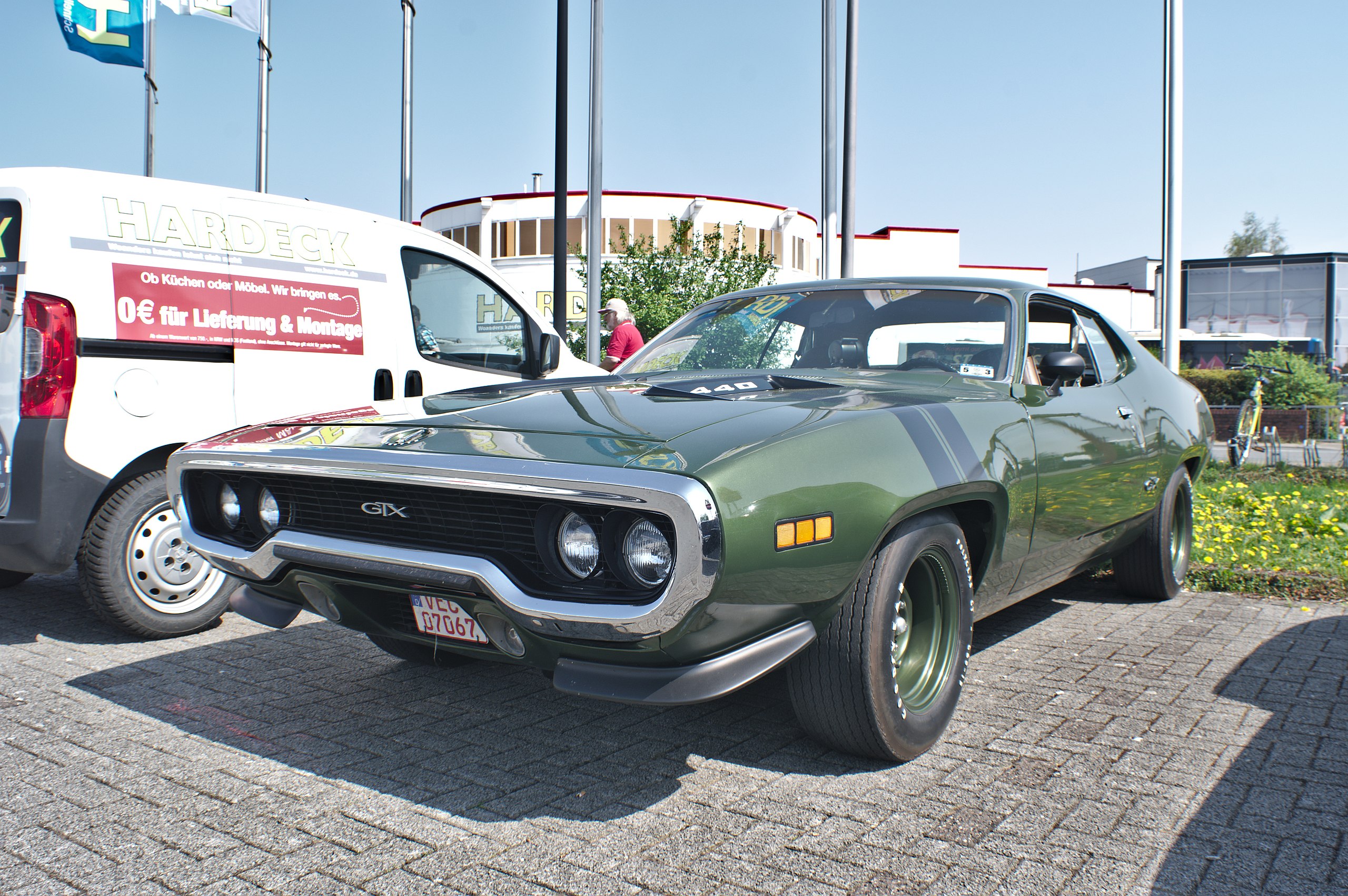
The final year of the Plymouth GTX was 1971, as sales completely collapsed. From a high of nearly 19,000 units in 1968, in 1971 Plymouth sold just 2,703. Buyers were opting for more fuel efficient cars in the wake of increasing oil and gas prices, and emissions cuts were right around the corner, anyways.
For 1971, Chrysler restyled their B-body, and as a result the GTX looks much different than other years. The new fuselage body replaced the hourglass of before, and it had a raked windshield, hidden cowl, and a newly designed bumper and grille. Like the year before, the GTX was only available as a hardtop, with the convertible not making a comeback.
Of the 2,703 GTX buyers in 1971, only 30 opted for the HEMI and 135 for the 440 six-pack. Of the 30 HEMIs, 11 had manual transmissions and 19 had the TorqueFlite automatic. Plymouth also increased the pricing on the GTX, with the base now coming in at $3,707. The 440 six-pack was a $125 option, while the HEMI cost an extra $747.
Engine Technical Specifications
| Model Years | Engine | Horsepower | Torque |
| 1971 | 426 HEMI V8 (2x4bbl) | 425 horsepower | 490 lb-ft |
| 1971 | 440 cid V8 (4bbl) | 370 horsepower | 480 lb-ft |
| 1971 | 440 cid V8 (3x2bbl) | 385 horsepower | 490 lb-ft |
For 1971, Plymouth kept the same GTX engine options, but again had to make some tweaks due to emissions restrictions. The base 440 Super Commando dropped compression further to 9.5:1, and also saw a loss of 5 horsepower/torque. In addition, Plymouth gave it a new carburetor again, this one a Carter AVS-4967-S four-barrel.
The six-pack Super Commando dropped compression to 10.3:1, and also had the same 5 horsepower/torque drop. Unchanged was the 426 HEMI, which had the same compression ratio, same 2×4 carburetors, and made the same 425 horsepower.
This was the last year for the GTX, which would have only dropped compression further and made even less power. Chrysler discontinued the HEMI for their entire lineup starting in 1972, so the GTX would not have even had it as an option anyways. As the ‘70s progressed, all the big muscle cars saw drops in power, with Plymouth at least having the decency to kill the GTX instead of neutering it.
1971 Plymouth GTX Production Numbers
| Model Year | Bodystyle | Production Total |
| 1971 | Hardtop (440) | 2,538 |
| Hardtop (440+6) | 135 | |
| Hardtop (HEMI) | 30 | |
| 1971 Total | 2,703 |
Plymouth GTX Legacy
The Plymouth GTX will forever be remembered as the ultimate Plymouth muscle car. It had everything: Sleek styling, big-block V8 power, and a not insane price tag. Unfortunately, even at its peak Plymouth produced less than 20,000 annually, meaning not so many have survived the five+ decades since its demise. Still, there are those 1967–1971 Plymouth GTXs that roam the wild, just waiting to go wide-open-throttle.
*Thanks to John Lee’s “Standard Catalog of Chrysler, 1924–1990” for engine and option information and production information.
**Thanks to John Gunnell’s “Standard Catalog of American Muscle Cars, 1960-1972” for engine and option information and production figures.